
Reading List # 117
An entirely subjective list of things happening in Berlin

March 16
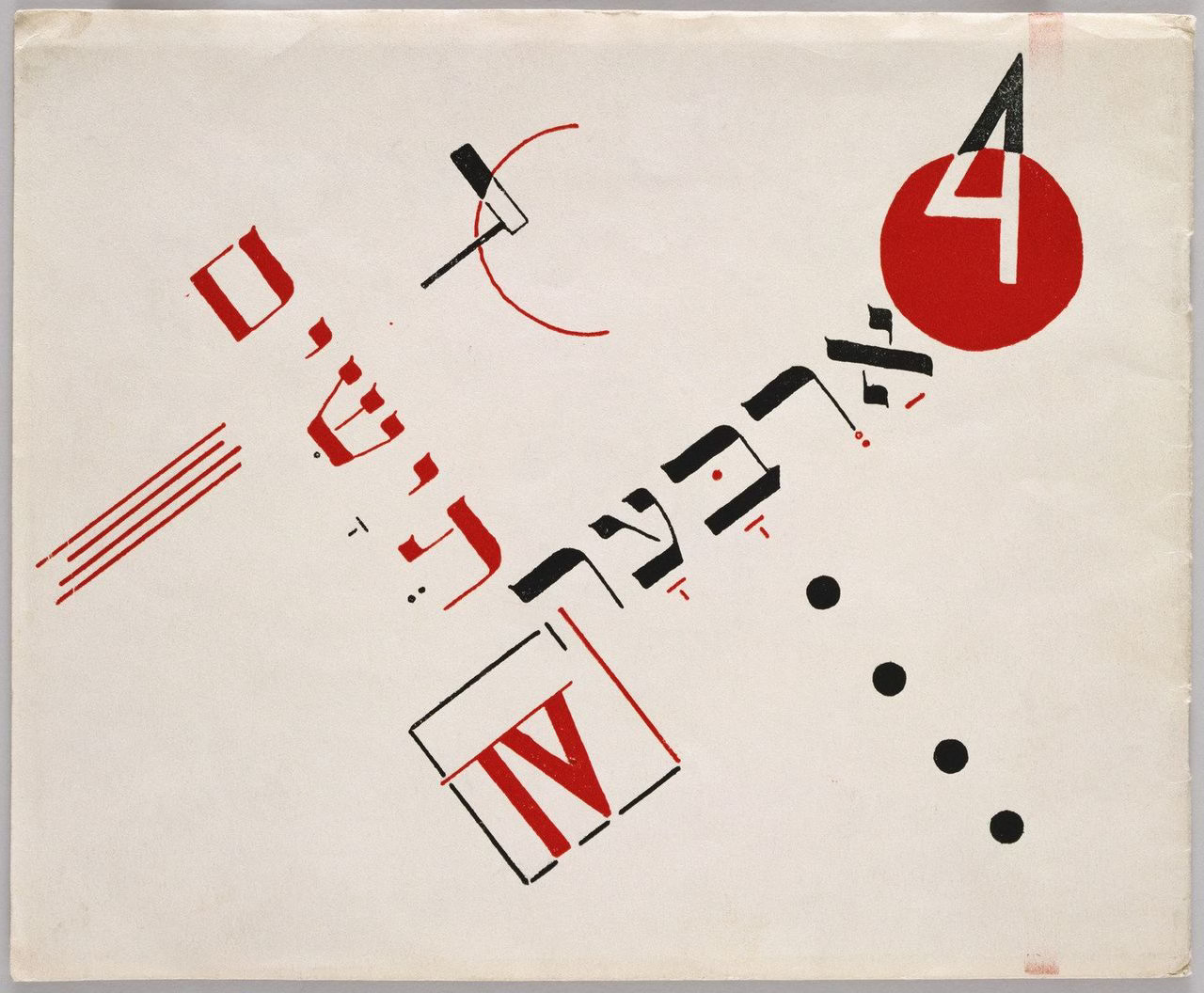
A Hundred Years of
The Future of the Book
There is little doubt, as El Lissitzky argues in The Future of the Book (1926), that ‘an alteration in the structure and mode of language implies a change in the usual appearance of the book’. Conversely, one can argue that the formal structures of the book shape not only physical and intellectual encounters with the object, but also future modes of thought.
Drawing on a vision of the future from a hundred years ago, this symposium asks what editorial experimentation can mean in the present and how the processes of book production – design, printing and distribution – influence the interpretation of the world. Drawing on five interrelated aspects articulated in El Lissitzky’s manifesto, the workshop explores (1) the material and political history of printing techniques examining the evolving relationship between materialism and dematerialization in contemporary society, (2) the concept of the book as architecture staging a unique encounter between ‘sound’ (time) and ‘exposure’ (space), (3) the role of writing in editorial experimentation, (4) the differential bodily experiences associated with various printing techniques (e.g. the immediacy of vision in American posters versus the deliberateness of reading in Russian revolutionary poster books), and (5) the modalities of reproduction and circulation.
(EN)
from 10 am | ICI Berlin, Christinenstr. 18-19
March 17
Matthias Nawrat - »Das glückliche Schicksal«
In 1983, the young Polish psychologist Wanda Karłowska travels to Venice to interview Henryk Mrugalski, who is living there in exile, about his research. Or is it an interrogation? Suspicion seems to hang between them, and yet there is a connection that points beyond who they are today. A game between equal opponents begins. The two delve deep into recent European history and raise questions that humanity itself poses to us. A captivatingly vivid novel about life and survival on both sides of the Iron Curtain.
Moderated by Gesa Ufer.
(DE)
8 pm | Literaturforum im Brecht-Haus, Chausseestr. 125
March 18
Butler Trouble - Zeitschrift für Ideengeschichte | Heft XX/1
When Judith Butler described the Hamas attacks as “armed resistance” in Paris in March 2024, the press was in an uproar. Criticism ranged from “disturbing coldness” to “intellectual capitulation.” Yet this controversy is only the latest in a long line: since *Gender Trouble* in 1990, Butler has been “much admired and much reviled” . Butler’s status reveals what global intellectualism means today—navigating the tension between the academic complexity of highly specialized debates and a pop-cultural aura with worldwide YouTube reach. The non-binary author is an iconic star in some circles, a demonized figure in others. Both are phenomena that cannot be explained by the person alone or by their often challenging texts. Butler’s academic work defies categorization into any single discipline: ranging from philosophy and rhetoric to the institutionalization of gender studies. The multifaceted body of work encompasses performativity theory, analyses of affects such as grief and anger, readings of Kafka, and statements on the Middle East question rooted in the history of ideas. The panel discussion wants to take Butler seriously as a phenomenon of theoretical and intellectual history: not to smooth over controversies, but to reframe them in light of the challenges and contested manifestations of global intellectualism in the present.
With Petra Gehring, Eva von Redecker, Thomas Meinecke and Diedrich Diederichsen. Moderation: Eva Geulen
(DE)
8 pm | Volksbühne am Rosa-Luxemburg-Platz, Linienstr. 227
March 19 - 20
Die Kalkulierbarkeit der Literatur. Praktiken, Diskurse, Mediendispositive
In the discourse of cultural criticism, decisions are often made very quickly regarding whether—and, if so, how—the various phenomena—namely, developments in media technology, the institutional restructuring of the literary world, and transformations in the relationship between “literature” and “the economy”—are interconnected, even though much remains unclear. From a literary studies perspective, it is therefore advisable to take a step back and examine the tension between literature and various dimensions of calculability in terms of its current and historical functional logics: How can the calculability of literature be differentiated against the backdrop of recent and older developments? Which practices, discourses, institutions, and media apparatuses must be taken into account? And which theoretical tools and quantitative analytical methods can be deployed to examine the broad spectrum of phenomena?
(DE)
from 12 pm | Humboldt-Universität, Raum 1066e, Unter den Linden 6